
One cap table, four sets of terms and five exit values, so you can see who gets paid what.
A liquidation preference decides who is paid first when a startup is sold or wound up. Under the standard 1x non-participating preference, investors take their money back or convert to common shares, whichever pays more. In Q2 2026, 96.4% of deals in Cooley’s sample were non-participating, and European data agrees. Participation, multiples and seniority shift value away from common shareholders.
Data as of 18 October 2026. Every waterfall on this page was calculated with the same model, and the market figures are dated where they appear. This is general information, not legal or investment advice: the exact rules sit in your company’s articles or charter.
What is a liquidation preference?
A liquidation preference is a right attached to preferred shares that pays their holders a set amount out of an exit before the holders of common shares receive anything. Investors in priced rounds usually buy preferred shares. Founders, employees and option holders hold common shares, or options over them.
The word “liquidation” is misleading. The preference applies when the company is wound up, but it also applies when the company is sold, because the documents define a sale or merger as a liquidation event. A Dutch practitioner note from Van Doorne puts it this way: apart from dissolution, liquidation or bankruptcy, “often also any change of control, including a sale or a merger are included” (Van Doorne, March 2023). In practice the preference matters most in an acquisition at a price below what investors hoped for.
The three variables: multiple, participation and seniority
Every liquidation preference is a combination of three settings.
| Variable | What it sets | Founder-friendly end | Investor-friendly end |
|---|---|---|---|
| Multiple | How much the investor is paid first, as a multiple of the amount invested | 1x: the money back | 2x or 3x: twice or three times the money |
| Participation | Whether the investor also shares in what is left after the preference | Non-participating: the preference or a conversion to common, whichever pays more | Participating: the preference and then a pro rata share of the rest, sometimes called the “double dip” |
| Seniority | The order in which classes of preferred are paid | Pari passu: all preferred classes are paid together, pro rata to their preference amounts | Senior: the newest investors are paid in full before earlier ones see anything |
A participation cap sits between the two ends of the participation row. The investor participates until its total payout reaches a set multiple of its investment, often 2x or 3x, and above that it can only do better by converting to common.
Exit waterfall examples at five exit values
An exit waterfall is the order in which the sale proceeds flow to each class of shareholder. All the examples below use the same company, and only the terms change.
| Shareholder | Shares | Ownership | Invested | Price per share |
|---|---|---|---|---|
| Common: founders and option pool | 5,500,000 | 55% | – | – |
| Seed preferred | 2,000,000 | 20% | $2M | $1.00 |
| Series A preferred | 2,500,000 | 25% | $10M | $4.00 |
| Total | 10,000,000 | 100% | $12M |
The Series A price of $4.00 per share across 10 million shares gives a $40M post-money valuation. The total preference at 1x is $12M. We look at exits of $8M, $15M, $30M, $60M and $150M. In every table, a non-participating or capped investor converts to common whenever that pays it more, given what the other investors do. When the money does not cover all the preferences in a tier, pari passu investors split it in proportion to their preference amounts. All amounts are in US dollars, millions. The arithmetic is the same in euros. Many pre-seed rounds, especially in Europe, use ordinary shares or convertible instruments with no preference at all; the tables apply once preferred shares are on the cap table.
1x non-participating (the market standard)
Each investor gets the larger of its money back or its ownership share of the exit as if it had converted to common.
| Exit value (USD M) | Common (USD M) | Common’s share of the exit | Seed (USD M) | Series A (USD M) | What happens |
|---|---|---|---|---|---|
| 8 | 0.00 | 0% | 1.33 | 6.67 | The exit is below the $12M of preferences, so both investors split it pro rata |
| 15 | 3.00 | 20% | 2.00 | 10.00 | Both take their money back; common shares the $3M left |
| 30 | 14.67 | 49% | 5.33 | 10.00 | Seed converts; Series A still takes its $10M |
| 60 | 33.00 | 55% | 12.00 | 15.00 | Both convert; everyone is paid by ownership |
| 150 | 82.50 | 55% | 30.00 | 37.50 | Both convert |
The conversion decision has a break-even point for each investor. Seed holds 2 million of the 7.5 million shares that share what is left after the Series A’s $10M, so converting pays it more than $2M once the exit passes $17.5M. Series A converts above a $40M exit, where 25% of the proceeds first beats its $10M. That is the post-money valuation of its own round. For the last investor in, with earlier investors already converted, a 1x non-participating preference works as downside protection up to the price it paid and stops mattering above it.
1x participating (the “double dip”)
Each investor takes its money back and then also shares in everything that is left, in proportion to its shares.
| Exit value (USD M) | Common (USD M) | Common’s share of the exit | Seed (USD M) | Series A (USD M) | What happens |
|---|---|---|---|---|---|
| 8 | 0.00 | 0% | 1.33 | 6.67 | Same as non-participating: the preferences absorb everything |
| 15 | 1.65 | 11% | 2.60 | 10.75 | $12M of preferences, then the $3M left is shared 55/20/25 |
| 30 | 9.90 | 33% | 5.60 | 14.50 | The $18M left is shared 55/20/25 |
| 60 | 26.40 | 44% | 11.60 | 22.00 | The $48M left is shared 55/20/25 |
| 150 | 75.90 | 51% | 29.60 | 44.50 | The $138M left is shared 55/20/25 |
Participation never switches off. Once non-participating investors would have converted, participation costs common its ownership share of the total preference, in this case 55% × $12M = $6.6M, at every exit size. That is why common’s $82.50M at $150M under the standard terms drops to $75.90M here. Common’s share approaches 55% as the exit grows, but it never reaches it.
Capped participation (1x participating, capped at 3x)
Each investor participates until its total payout reaches 3x its investment: $6M for Seed and $30M for Series A. Above the cap it keeps the capped amount, or converts to common if that pays more.
| Exit value (USD M) | Common (USD M) | Common’s share of the exit | Seed (USD M) | Series A (USD M) | What happens |
|---|---|---|---|---|---|
| 8 | 0.00 | 0% | 1.33 | 6.67 | Same as above |
| 15 | 1.65 | 11% | 2.60 | 10.75 | No cap is reached, so this is the same as uncapped participation |
| 30 | 9.90 | 33% | 5.60 | 14.50 | No cap is reached |
| 60 | 27.50 | 46% | 10.00 | 22.50 | Seed hit its $6M cap at a $32M exit and converted above $40M; Series A still participates |
| 150 | 82.50 | 55% | 30.00 | 37.50 | Series A hit its $30M cap at $90M and converted above $120M; same result as non-participating |
A cap creates a flat zone for each investor. Seed’s payout stays at $6M for any exit between $32M and $40M, and Series A’s stays at $30M between $90M and $120M, before each converts. Inside those zones every extra dollar of exit value goes to the other shareholders. A cap therefore limits participation to the middle range of outcomes. At large exits it behaves like the standard terms, and at small exits it behaves like full participation.
Stacked and senior preferences (Series A 2x senior, Seed 1x junior)
Here the Series A has a 2x non-participating preference, $20M, paid in full before the Seed investor gets anything. Seed keeps a 1x non-participating preference, junior to the Series A.
| Exit value (USD M) | Common (USD M) | Common’s share of the exit | Seed (USD M) | Series A (USD M) | What happens |
|---|---|---|---|---|---|
| 8 | 0.00 | 0% | 0.00 | 8.00 | Series A takes everything, as it is senior |
| 15 | 0.00 | 0% | 0.00 | 15.00 | Series A takes everything; its $20M preference is not yet covered |
| 30 | 7.33 | 24% | 2.67 | 20.00 | Series A takes $20M; Seed converts to share the $10M left |
| 60 | 29.33 | 49% | 10.67 | 20.00 | Series A still takes its $20M rather than converting into 25% ($15M) |
| 150 | 82.50 | 55% | 30.00 | 37.50 | Both convert |
The two settings do different jobs. Seniority only decides who absorbs the shortfall when the exit is smaller than the preferences. With a 1x senior Series A and the same cap table, the waterfall changes only below a $12M exit: at $8M, Series A takes all $8M instead of $6.67M, and Seed gets nothing instead of $1.33M. Above $12M the result is identical to the pari passu table. The 2x multiple reaches much further. Common receives nothing until the exit passes $22M, and the Series A does not convert until the exit passes $80M, which is twice its post-money valuation.
Summary: common’s share of the exit under each structure
| Exit value (USD M) | 1x non-participating | 1x participating | Participating, 3x cap | Series A 2x senior |
|---|---|---|---|---|
| 8 | 0% | 0% | 0% | 0% |
| 15 | 20.0% | 11.0% | 11.0% | 0% |
| 30 | 48.9% | 33.0% | 33.0% | 24.4% |
| 60 | 55.0% | 44.0% | 45.8% | 48.9% |
| 150 | 55.0% | 50.6% | 55.0% | 55.0% |
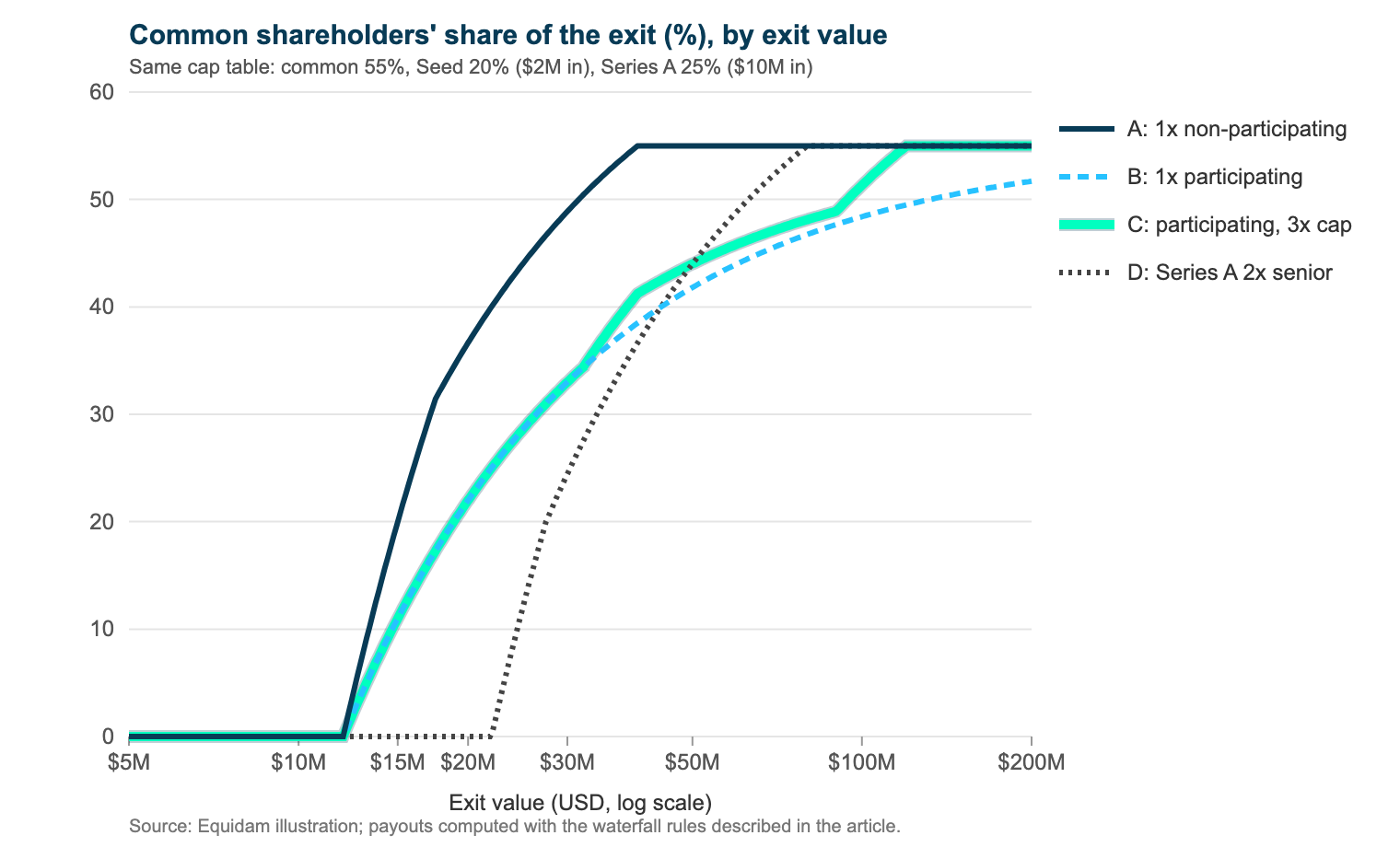
Common shareholders own 55% of the shares in every case. What they receive depends on the terms and on the size of the exit.
The four structures differ most in the middle range of outcomes, from a little below the total amount invested up to a few times the last post-money valuation. That range includes the sale below the hoped-for price, which is the case a preference is written for.
What is standard in 2026?
The short answer is a 1x, non-participating preference that ranks pari passu with earlier rounds. Law-firm deal data from both sides of the Atlantic points the same way. In Orrick’s European sample, the 23% of financings without a 1x non-participating preference were mostly rounds with no preference at all (14%) or other bespoke constructs (8%), not participation.
| Source | Sample | 1x preference | Non-participating | Senior preference |
|---|---|---|---|---|
| Cooley, Q2 2026 | 166 financings handled by Cooley | 95.8% of deals | 96.4% of deals | Not reported |
| Cooley, Q4 2025 | 221 financings handled by Cooley | 98% | 96% | Not reported |
| Wilson Sonsini, H1 2026 | Wilson Sonsini deals with a first closing in H1 2026 | Not reported | 97% (1% capped participating, 2% uncapped) | 16% of Series B and later rounds |
| Orrick, Europe 2025 | 400+ venture and growth investments by Orrick clients in Europe | 77% had a 1x non-participating preference | Participating in about 1%, down from 7% in 2024 | Not reported |
Terms get heavier when founders have less leverage. In Wilson Sonsini’s 2025 data, 46% of Series B and later down rounds gave the new money a senior preference, against 12% of up rounds (Wilson Sonsini, Q2 2026 report, appendix). Carta saw the same cycle in participation: 4.8% of rounds on its platform had participating preferred in Q4 2021, 15.6% in Q1 2023 and 6.1% by Q3 2023 (Carta, November 2023).
The standard has held through 2026. Wilson Sonsini reports that senior preferences have declined from their 2022 highs and appeared “in 16% of Series B and later financings in 1H 2026” (Wilson Sonsini). Orrick found that participating preferences “virtually disappeared” in its 2025 European deals, falling from 7% to about 1% (Orrick Deal Flow 2025–26).
Keep in mind that these are samples from law firms, not the whole market. Each firm reports on its own clients’ deals. They point the same way, which is why we treat 1x non-participating as the norm, but none of them is a census.
Liquidation preferences in the US and Europe
The mechanics are the same in both markets. What differs is where the terms are written and how often they are used.
In the US, preferences are written into the company’s certificate of incorporation as rights of a class of preferred stock, usually starting from the NVCA model documents. In European companies they sit in the articles of association, and often in the shareholders’ agreement, as an agreed order for distributing proceeds. Van Doorne notes that a Dutch non-participating clause can be phrased so the investor chooses between its preference and its as-converted amount “to prevent the need for actual conversion” (Van Doorne).
More early European rounds have no preference at all. In Orrick’s 2025 European sample, 14% of financings had no liquidation preference, up from 9%, mostly earlier-stage rounds (Orrick).
Dutch practice has matched the US norm. Van Doorne wrote in March 2023 that a 1x non-participating preference with a conversion right was most common in Dutch seed and Series A rounds, that 2x and 3x multiples were “very uncommon for healthy companies” and that pari passu ranking was market practice. It also reported that new investors in down rounds were insisting on senior preferences (Van Doorne). That is a practitioner view, not a dataset.
How liquidation preferences change what your valuation means
A headline valuation is a price per share multiplied by all the shares, and it assumes every share is worth what the newest investor paid. Preferred shares are worth more than common shares because of their preferences, so the headline overstates what the common shares are worth. In a 2017 working paper, Gornall and Strebulaev applied this to 135 US unicorns and found that their reported post-money valuations were on average 50% above the fair value they estimated once the share classes were valued separately (NBER working paper 23895).
At seed and Series A the effect is smaller, but it works the same way. Two Series A offers of $10M for the company above show it. In both, Seed keeps its 1x non-participating preference.
| Exit value (USD M) | Common receives, offer 1: $40M post-money, 1x non-participating (USD M) | Common receives, offer 2: $50M post-money, 1x participating (USD M) |
|---|---|---|
| 20 | 7.33 | 5.87 |
| 30 | 14.67 | 11.73 |
| 60 | 33.00 | 29.33 |
| 100 | 55.00 | 52.80 |
| 150 | 82.50 | 82.13 |
| 300 | 165.00 | 170.13 |
Offer 2 looks better on the term sheet: a higher valuation and 58.7% left for common instead of 55%. Common does better with offer 2 only if the company is sold for more than $160M, four times the lower offer’s post-money. A higher price with heavier terms can be the worse deal for founders and employees across most realistic exits.
This is why we say the best startups are valued, not priced. A round’s price is shaped by competition, hype and terms, while a valuation is an estimate of what the business is worth under stated assumptions. The zero-interest-rate years showed what happens when the two drift apart: high headline prices came with what our valuation book calls “dirty term sheets”, and participation on Carta peaked in early 2023 as that market turned. Equidam estimates a company’s pre-money value with five methods: Scorecard, Checklist, the VC method, DCF with long-term growth and DCF with multiples, where the DCF methods apply survival rates and an illiquidity discount. The weights change with the company’s stage. Our guide to the five valuation methods explains each one. That estimate is for the company as a whole. How an exit is split between share classes is then decided by the terms, which is what the waterfall shows. Heavy terms are uncommon in ordinary seed and Series A rounds. They cluster in late-stage, high-price and down rounds, which is where stories like Divvy and Freetrade sit. For the opinion side of this, read how a $1B exit can leave founders with nothing.
What employees should know about liquidation preferences
Employee options are options over common shares, so every preference sits ahead of them. Ask for the total preference stack in euros or dollars and the participation terms of each round, because that tells you the exit value below which your options pay nothing. Our article on what your startup equity is actually worth works through the full calculation, including dilution and tax.
How to negotiate liquidation preferences
Treat the preference as part of the price. Four rules follow from the tables:
- Compare offers at several exit values. Run each term sheet through a waterfall at the exits you consider realistic, not only at the headline valuation.
- Push back first on participation and multiples. They cost common money across the widest range of exits. Seniority matters only when the exit is smaller than the total preference, but that is exactly the exit where it decides whether you get anything, so don’t treat it as a free concession.
- If participation is the price of the deal, ask for a cap. A 2x or 3x cap returns the upside to common once the company does well.
- Watch the precedent. Terms you accept in one round become the starting point for the next investor, who will often ask for the same rights or better.
None of this needs to be adversarial. A clean 1x non-participating preference is the norm in the data above, and asking for it is an ordinary request. For a broader view of the round, see why negotiating value rather than price leads to better deals, and how dilution adds up across rounds. If your company is facing a lower round, our guide to down rounds covers the terms that tend to come with it. If you are preparing for a sale, the starting point is an estimate of what the whole company is worth: see startup exit valuation.
FAQ
What does 1x non-participating mean?
The investor receives either its original investment back or the amount it would get by converting its preferred shares into common shares, whichever is larger, but not both. In the example above, a Series A investor with $10M in and 25% of the shares takes $10M at any exit up to $40M and converts above that.
What does a 2x liquidation preference mean?
The investor is paid twice its investment before common shareholders receive anything. On $10M invested, that is the first $20M of the exit. If the preference is non-participating, the investor converts only when its ownership share is worth more than $20M, which for a 25% holder means an exit above $80M.
Are participating preferences common?
Not in current data. Cooley reported non-participating preferred in 96.4% of its Q2 2026 deals, and Orrick found participating preferences in about 1% of its 2025 European deals. They become more common in hard markets: on Carta, participation rose to 15.6% of rounds in Q1 2023 before falling back to 6.1% in Q3 2023.
What is the difference between senior and pari passu?
Pari passu means all classes of preferred are paid at the same time and share any shortfall in proportion to their preferences. Senior means one class, usually the newest, is paid in full before the next class gets anything. Seniority only changes the outcome when the exit is too small to cover every preference.
Do liquidation preferences apply in an IPO?
Typically not. Venture preferred shares usually convert automatically into common shares when the company lists, so the preferences fall away. Brad Feld notes that bankers “will want to see everyone convert into common stock at the time of the IPO” (Feld). The exact thresholds are in the company’s charter or articles.
Do SAFEs have a liquidation preference?
Yes, in effect. In a sale before conversion, the standard Y Combinator post-money SAFE pays the greater of the purchase amount or the as-converted amount, and “is intended to operate like standard non-participating Preferred Stock” (Y Combinator SAFE). See how SAFEs convert.