
Median valuations and round sizes at seed, Series A and Series B in the US and the UK, with pre-seed data for the US and Europe, from the latest primary reports. Every figure is labelled with its source, date and basis.
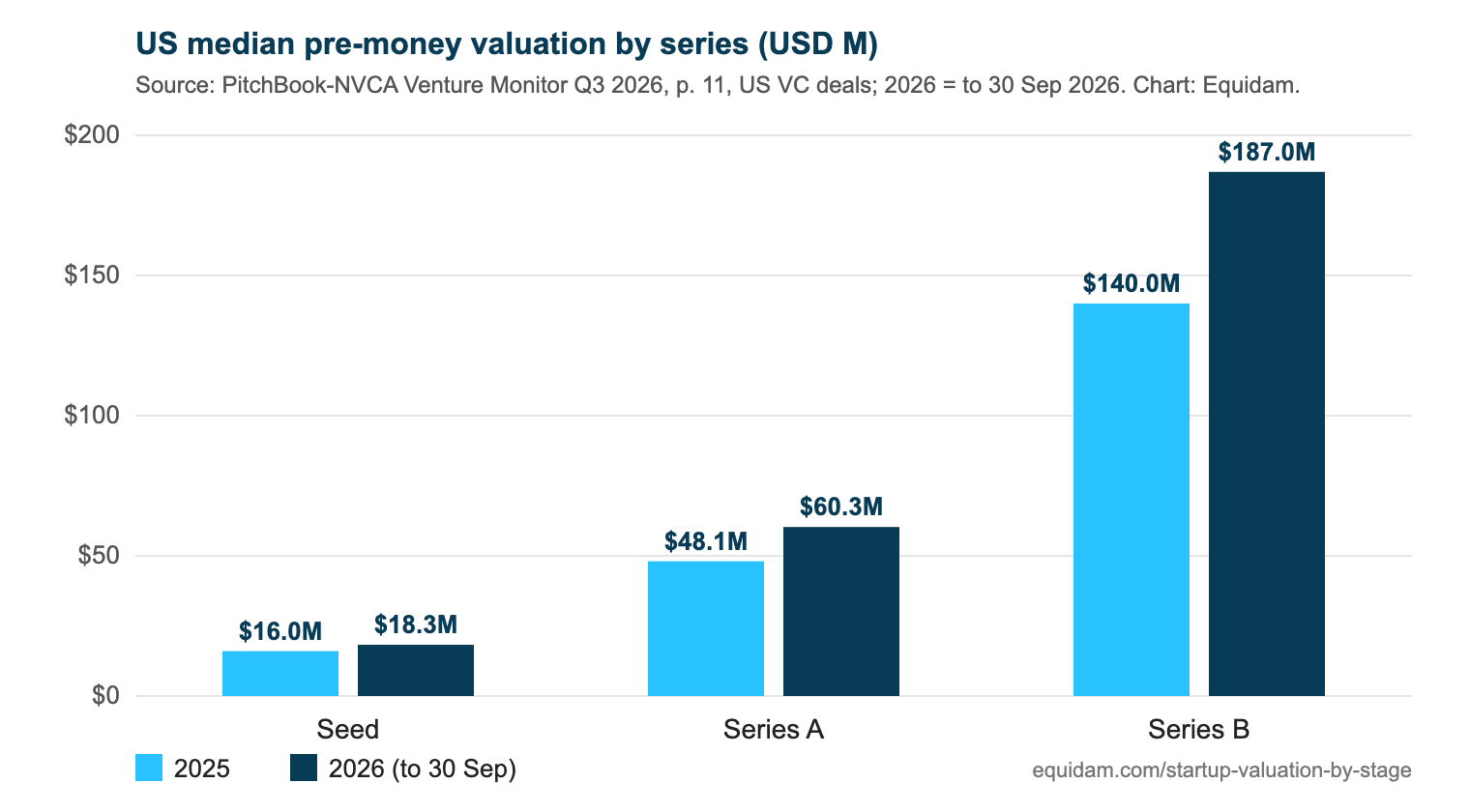
The US median pre-money valuation in 2026 (to 30 September) was $18.3M at seed, $60.3M at Series A and $187.0M at Series B (PitchBook-NVCA). Pre-seed valuations founders ran on Equidam before raising had a median of $5.20M in H1 2026 (Valuation Delta). UK seed-stage companies raising equity had a median pre-money of £2.0m in H1 2026 (Beauhurst).
Data as of 18 October 2026. Compiled by Equidam from PitchBook-NVCA (data to 30 September 2026), Carta, Cooley, Beauhurst and Equidam’s own pre-seed and announced-round data. Next update: January 2027.
Startup valuations by stage: the 2026 table
A pre-money valuation is the value of a startup before the new investment goes in. The post-money valuation adds the new money on top. Pre-seed follows below the table. Most of the figures are pre-money medians: the middle deal when all deals in the sample are lined up from smallest to largest.
| Stage | US median pre-money (USD M), PitchBook-NVCA, 2026 to 30 Sep | US median round size (USD M), PitchBook-NVCA, 2026 to 30 Sep | US software median post-money (USD M), Carta, 6 months to 10 Jul 2026 | UK median pre-money (GBP m), Beauhurst, H1 2026 |
|---|---|---|---|---|
| Seed | 18.3 | 3.0 | 24.3 (on 4.1 raised) | 2.0 (Beauhurst “seed” stage) |
| Series A | 60.3 | 17.4 | 80.0 (on 14.4 raised) | 5.3 (Beauhurst “venture” stage)¹ |
| Series B | 187.0 | 39.5 | 190.9 (on 25.0 raised) | No series split¹ |
Sources: PitchBook-NVCA Venture Monitor Q3 2026, p. 11, US-headquartered VC deals; Carta, software fundraising benchmarks, 1,133 US software rounds on Carta, post-money; Beauhurst, The Deal H1 2026, UK equity deals.
- Beauhurst groups UK companies by “stage of evolution” (seed, venture, growth), not by funding series, so its stages do not map one-to-one to Series A and B. We show its venture stage on the Series A row for reference only. Its later “growth” stage fell 23% from £25.9m; Beauhurst does not state the H1 2026 level, and we have not calculated one.
A stage median tells you where the middle of the market was. It does not tell you what your company is worth. Use it as context and as a sanity check on a number you have built yourself, not as the price. Investors at every stage are looking for the companies that will not end up in the middle.
For pre-seed, Equidam’s H1 2026 Valuation Delta, built from valuations run on our platform, shows a median of $5.20M across all regions. The same edition shows $5.16M for the US and $3.30M for Europe (Valuation Delta H1 2026). These are valuations founders ran on Equidam while preparing to raise, not prices of closed rounds. Each Valuation Delta figure is the average of that period’s quarterly medians, weighted by the number of valuations in each quarter, which is why the edition’s regional table labels its columns “Avg.”.
For Europe from seed to Series B, PitchBook publishes medians by series in its Q2 2026 European VC Valuations Report. We have not included them yet, because we only quote figures we have checked in the original report.
A cross-check from a law-firm sample: among the 166 deals Cooley handled in Q2 2026, the median Series B pre-money valuation was $185.2M, up from $152.5M in Q1. That sits close to PitchBook’s $187.0M for the year to date.
Series C, for reference: the US median pre-money was $500.0M in 2026 to 30 September, on a median round of $77.0M (PitchBook-NVCA).
Converted at the ECB reference rates for 30 September 2026 (EUR/USD 1.1355, EUR/GBP 0.85463, so about $1.33 per £1), the UK seed median of £2.0m is about $2.7M and the venture-stage median of £5.3m about $7.0M. We show local currency as the main figure because exchange rates move.
Why do sources give different numbers?
Even on this page, a 2026 Series A appears as $60.3M (PitchBook, US, pre-money), $80.0M (Carta, US software, post-money) and $55M (Carta, non-AI companies, Q1, basis not stated). None of these is wrong. They measure different things, and most of the gap comes from five differences.
| Difference | What to check | Example from this page |
|---|---|---|
| Pre-money or post-money | Post-money = pre-money + the new money | Carta’s seed median is $24.3M post-money; PitchBook’s is $18.3M pre-money |
| Median or average | A few huge rounds lift an average; a median ignores them | UK AI companies: average pre-money £70.2m, median £3.4m (Beauhurst) |
| Closed rounds or platform valuations | Closed rounds are prices investors paid; platform valuations are estimates made before raising | PitchBook, Carta, Cooley and Beauhurst count closed rounds; Equidam’s pre-seed data counts valuations run while preparing to raise |
| Which deals are in the sample | Country, sector, data source, deal types | PitchBook: all US VC deals it tracks; Carta: US software companies on Carta, no bridges; Cooley: 166 deals its lawyers worked on |
| Which period | Year to date, half-year, quarter, trailing six months | PitchBook 2026 to 30 Sep; Carta six months to 10 Jul; Beauhurst H1 2026 |
There is a sixth factor that cuts across all five: AI. In 2026, US AI companies raised at higher median valuations than the overall market at every series PitchBook reports, so the share of AI deals in a sample moves its median (see AI vs non-AI below).
The practical rule: compare figures from one source at a time, on the same basis. Say an investor quotes Carta’s $24.3M seed figure against your $15M pre-money valuation. Carta’s number is post-money and covers only software companies, so it is not a like-for-like comparison.
Pre-seed: what the data shows
Pre-seed valuations run on Equidam in H1 2026 had a median of $5.20M, almost unchanged from $5.28M across 2025, on a median planned raise of $0.52M (Startup Valuation Delta H1 2026). For the full series since 2019, regional detail and how we measure it, see the Valuation Delta hub. An earlier single-quarter snapshot for Q1 2026 showed $5.87M on a smaller sample; the H1 2026 edition replaces it.
On Carta, 93% of pre-seed rounds in Q2 2026 were SAFEs, which carry a valuation cap rather than a priced valuation; median post-money caps ranged from $10M to $35M depending on SAFE size (Carta). Our guide to SAFE caps and discounts explains how to set one.
How much do valuations step up between rounds?
Dividing each US stage median by the one before gives a rough step-up between stages.
| Step | Ratio of medians, 2025 | Ratio of medians, 2026 to 30 Sep |
|---|---|---|
| Seed → Series A | 3.0x | 3.3x |
| Series A → Series B | 2.9x | 3.1x |
| Series B → Series C | 2.2x | 2.7x |
Calculated by Equidam from PitchBook-NVCA median pre-money valuations (Q3 2026 Venture Monitor, p. 11).
Read this as a ratio of medians, not as what a typical company gets. The median seed deal and the median Series A deal in 2026 belong to different companies. Only part of each seed cohort goes on to raise a Series A, and those that do tend to be the stronger ones, so the ratio overstates the step-up for any one company. PitchBook also tracks step-ups company by company. On that measure, pooled across rounds rather than split by series, the median step-up in 2026 was 2.2x for AI companies and 1.5x for non-AI companies (PitchBook-NVCA, p. 16).
The growth was uneven across stages. From 2025 to 2026, the US median pre-money rose 14% at seed, 25% at Series A, 34% at Series B and 107% at Series D and later. Valuations moved most at the late stage and least at seed. Our own pre-seed median barely moved over the same period: $5.28M in 2025 and $5.20M in H1 2026 (Valuation Delta H1 2026).
If you are looking for revenue multiples rather than step-ups, see our revenue multiples by industry and our guide to valuing a startup with multiples.
How much do startups raise at each stage?
In 2026 to 30 September, the median US VC deal was $3.0M at seed, $17.4M at Series A and $39.5M at Series B (PitchBook-NVCA, p. 11). Seed was the only series where the median round shrank, from $3.4M in 2025. Series A rounds grew 27% and Series B rounds 32%.
Carta’s sample of US software rounds shows a median of $4.1M raised at seed, $14.4M at Series A and $25.0M at Series B (Carta). Its seed rounds are larger than PitchBook’s and its Series A and B rounds smaller, another reminder that samples differ.
For pre-seed round sizing, see our guide on how much to raise, and when. For how much of the company each round typically costs, see how much equity to give investors per round.
US vs Europe vs UK
On these two sources, the UK sits far below the US. Beauhurst’s median UK seed pre-money of £2.0m (about $2.7M) compares with $18.3M for a US seed round on PitchBook, and its venture-stage median of £5.3m (about $7.0M) is lower than the US seed median. Part of that gap is definitional: Beauhurst groups UK deals by the company’s stage of evolution, while PitchBook classifies US deals by funding series, so the two “seed” groups are not built the same way. Part of it is the market. Seed was the only Beauhurst stage to gain ground in H1 2026, up 13%, while venture-stage valuations fell to their lowest level in the period Beauhurst shows (Beauhurst).
Announced rounds show a much smaller gap. Among seed rounds with a published valuation on Crunchbase, announced from January 2024 to July 2026, the median pre-money valuation was $7.00M in the US and $6.59M in the UK, after removing outliers above about $25.5M (Equidam internal data, July 2026). Our page on startup valuation by country explains the method and gives figures for 88 countries and territories. These rounds are not limited to deals with a venture fund, and the outlier rule drops the largest seed rounds, so the US figure sits well below PitchBook’s.
For continental Europe, the summary page of PitchBook’s report says that pre-seed valuations declined in the first half of 2026 even as deal sizes grew, while later-stage rounds kept a valuation premium (PitchBook, Q2 2026 European VC Valuations Report). Pre-seed valuations run on Equidam came out at $3.30M in Europe in H1 2026, against $5.16M in the US (Valuation Delta H1 2026).
For the policy side of the gap, see Europe vs US: valuations, ESOPs and policy.
AI vs non-AI
US AI companies raised at a median pre-money of $21.0M at seed, $78.0M at Series A and $266.3M at Series B in 2026 to 30 September, against $18.3M, $60.3M and $187.0M for all deals (PitchBook-NVCA, pp. 11 and 16). Carta’s Q1 2026 report shows a wider gap: an AI foundational-model startup at Series A “might be raising at a $300 million median valuation”, while a non-AI startup at the same stage “is at $55 million” (Carta, State of Private Markets Q1 2026). In the UK, AI seed companies were valued around 25% above the wider seed median in H1 2026 (Beauhurst).
Using a stage benchmark for your own round
Start from your own valuation. One built from your own plan is easier to explain and defend in a negotiation than one borrowed from a table. Equidam combines five methods: the Scorecard, Checklist, VC method, DCF with long-term growth and DCF with multiples, explained in our guide to the five startup valuation methods. The default weights change with the company’s stage. At the idea stage, the two qualitative methods (Scorecard and Checklist) carry 76% of the weight. At the expansion stage they carry 12%, and the two DCF methods carry 72% (Equidam sample valuation report, p. 20). That mirrors how investors shift from judging the team and market to judging the numbers as a company grows.
Once you have your own number, compare it with the right row above, on the same basis (pre or post-money), and be ready to explain the difference.
FAQ
What is the average Series A valuation in 2026?
The median US Series A pre-money valuation was $60.3M in 2026 to 30 September, on a median round of $17.4M, according to PitchBook-NVCA. Carta’s sample of US software rounds shows a median post-money valuation of $80.0M. Post-money includes the new investment, so the two figures are not directly comparable.
What is a typical seed valuation in Europe?
In the UK, the median seed pre-money valuation was £2.0m (about $2.7M) in H1 2026, according to Beauhurst. Announced UK seed rounds on Crunchbase from January 2024 to July 2026 had a higher median of $6.59M (Equidam data). We could not verify a 2026 continental European seed median from a primary source. At pre-seed, valuations run on Equidam in Europe came out at $3.30M in H1 2026.
How much do valuations increase from seed to Series A?
There is no single answer. In the US in 2026, the median Series A pre-money was 3.3 times the median seed pre-money (PitchBook-NVCA), but that compares different companies. Tracked company by company and pooled across rounds, PitchBook’s median step-up in 2026 was 1.5x for non-AI and 2.2x for AI companies.
Are these pre-money or post-money valuations?
PitchBook-NVCA, Cooley and Beauhurst figures are pre-money. Carta’s software benchmarks are post-money, which includes the money raised in the round. Equidam’s figures are pre-money valuations, as shown in our sample report, run before raising. Always check the basis before comparing your number with a benchmark.
Why is Equidam’s pre-seed number lower than US seed figures?
It measures an earlier stage and a different thing. Equidam’s $5.20M median covers companies with no product beyond an MVP and no VCs, worldwide, valued while preparing to raise. PitchBook’s $18.3M is the median closed US seed round: a later stage, a single country with higher prices, and a price agreed with investors.
How often is this page updated?
Twice a year, in January and July, alongside the Valuation Delta editions. Each update uses the latest PitchBook-NVCA, Carta, Beauhurst and Equidam data available at the time. The “Data as of” date at the top shows when the figures were last refreshed.
Cite as: Equidam, Startup Valuation by Stage (compiled from PitchBook-NVCA, Carta, Cooley, Beauhurst and Equidam data), October 2026, https://www.equidam.com/startup-valuation-by-stage/. For third-party figures, please cite the original source.
This page compiles public data from PitchBook-NVCA, Carta, Cooley and Beauhurst. Equidam did not produce the PitchBook-NVCA, Carta, Cooley or Beauhurst figures. The pre-seed figures and the announced-round seed medians are Equidam’s own published data.